
Yarn Weight Chart
Yarn weight describes how thick a yarn is, not how heavy the ball is. This chart lists the eight standard categories from lace (0) to jumbo (7) with the gauge, needle and hook sizes usually recommended, and the calculator helps you identify an unlabelled yarn from wraps per inch or yardage and work out how many skeins you need when substituting a different yarn.
- Free to use
- No sign-up
- Runs in your browser
Yarn weight and substitution calculator
Yarn Weight & Project Planner Pack
Printable yarn weight chart (categories 0–7), a WPI measuring card, a needle and hook size conversion chart, a yarn substitution worksheet and an Excel stash inventory.
- Yarn weight chart (PDF/XLSX)
- Needle & hook sizes (PDF)
- WPI card (PDF)
- Substitution worksheet (XLSX)
- Stash inventory (XLSX)
Formats: PDF, XLSX. Instant download after payment (link valid 72 hours, up to 5 downloads). AI-assisted: the templates were drafted with AI help and reviewed and laid out before publishing.
$3.00 USD, one-time 5 files · about $0.60 each
- Instant download
- 7-day refund
- Secure checkout by Stripe
7-day money-back guarantee. Full refund within 7 days of purchase, even after you download.
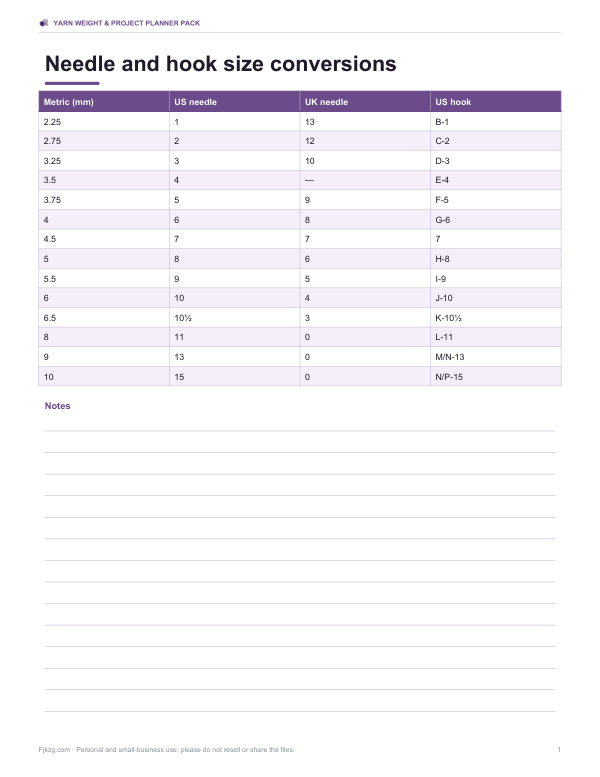
Free sample: Needle Hook Size Chart (PDF, 105 KB)
Full refund within 7 days — see the refund policy and license.
Free printables
Single sheets you can print right now, no sign-up. The full pack adds every sheet in one download plus the editable files.
 Printable Yarn Substitution Worksheet
 Printable Yarn Stash Inventory Sheet
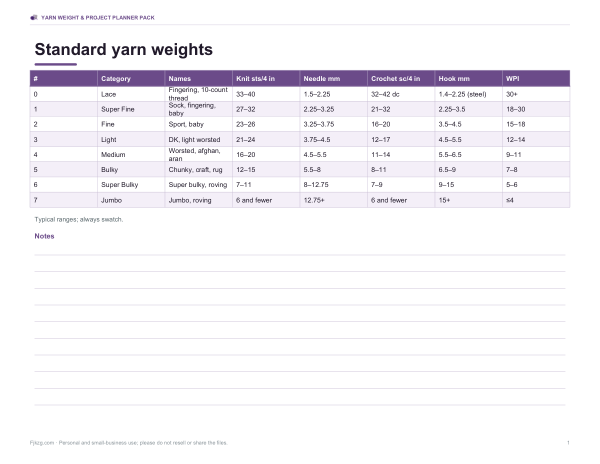
Standard yarn weight chart
| # | Category | Common names | Knit gauge (sts / 4 in) | Needle (mm) | Crochet gauge (sc / 4 in) | Hook (mm) |
|---|---|---|---|---|---|---|
| 0 | Lace | Fingering, 10-count thread | 33–40 | 1.5–2.25 | 32–42 dc | 1.4–2.25 (steel) |
| 1 | Super Fine | Sock, fingering, baby | 27–32 | 2.25–3.25 | 21–32 | 2.25–3.5 |
| 2 | Fine | Sport, baby | 23–26 | 3.25–3.75 | 16–20 | 3.5–4.5 |
| 3 | Light | DK, light worsted | 21–24 | 3.75–4.5 | 12–17 | 4.5–5.5 |
| 4 | Medium | Worsted, afghan, aran | 16–20 | 4.5–5.5 | 11–14 | 5.5–6.5 |
| 5 | Bulky | Chunky, craft, rug | 12–15 | 5.5–8 | 8–11 | 6.5–9 |
| 6 | Super Bulky | Super bulky, roving | 7–11 | 8–12.75 | 7–9 | 9–15 |
| 7 | Jumbo | Jumbo, roving | 6 and fewer | 12.75+ | 6 and fewer | 15+ |
These are the standard yarn weight guidelines published by the Craft Yarn Council and printed on many yarn labels as a numbered ball symbol. They are typical ranges; your pattern’s gauge always takes priority.
Wraps per inch and yardage
| Category | Approx. WPI | Approx. yards per 100 g |
|---|---|---|
| 0 Lace | 30+ | 600+ |
| 1 Super Fine | 18–30 | 350–600 |
| 2 Fine | 15–18 | 250–350 |
| 3 Light | 12–14 | 200–250 |
| 4 Medium | 9–11 | 120–200 |
| 5 Bulky | 7–8 | 80–120 |
| 6 Super Bulky | 5–6 | 40–80 |
| 7 Jumbo | ≤4 | <40 |
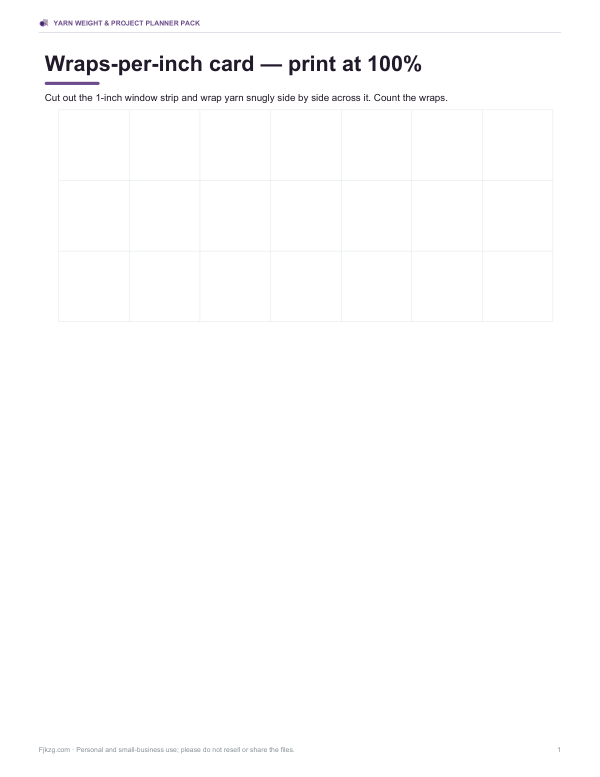
Wraps per inch (WPI) is a quick way to identify unlabelled yarn: wrap it snugly, without stretching, around a ruler or WPI tool for one inch and count the strands. Yardage per 100 g depends on fibre as well as thickness — fluffy mohair or airy chainette yarns can have more yardage than a dense yarn of the same thickness.
What yarn weight really means
Despite the name, yarn weight is about thickness. A 100 g ball of lace-weight yarn might hold 800 yards, while 100 g of bulky yarn might have 120 yards. Using the right weight for a pattern matters because it controls the fabric’s gauge — how many stitches fit in an inch — and therefore the size of the finished item. A sweater knit in worsted from a DK pattern could end up several inches too big.
Regional names
| US | UK | Australia / NZ |
|---|---|---|
| Fingering | 4-ply | 4-ply |
| Sport | 5-ply (approx.) | 5-ply |
| DK | DK / 8-ply | 8-ply |
| Worsted | Aran (approx.) | 10-ply |
| Aran | Aran | 10-ply |
| Bulky | Chunky | 12-ply |
| Super bulky | Super chunky | 14-ply+ |
“Ply” once described how many strands were twisted together, but today it is used as a thickness name in some countries and does not always match the actual number of plies.
Substituting yarn
- Match the weight category and, ideally, the fibre, which affects drape and stretch.
- Check the pattern’s gauge and knit or crochet a swatch with the new yarn.
- Adjust needle or hook size until your swatch matches the gauge.
- Work out the total yardage the pattern needs (skeins × yards per skein).
- Divide by the new yarn’s yards per skein and round up, plus one extra skein for safety.
- Buy skeins from the same dye lot.
Always calculate by length (yards or metres), not by weight in grams — different fibres have very different yardage per gram.
Worked example
A worsted-weight hat pattern calls for five skeins of a 220-yard yarn — 1,100 yards. Your substitute has 190 yards per 100 g skein and wraps about 10 times per inch. The calculator identifies it as category 4 (Medium) from both WPI and yardage, and shows you need 5.79 skeins — so buy six, or seven for safety. A quick swatch confirms 18 stitches per 4 inches on 5 mm needles, matching the pattern.
Fibre and weight together
Two yarns of the same weight can behave very differently. Wool is elastic and forgiving; cotton and linen are inelastic and heavier, so garments may drop or grow; alpaca is warm and drapey but less springy; acrylic is easy-care and affordable. When substituting, try to match fibre characteristics as well as weight, or expect the finished fabric to feel and hang differently. Blends often combine the best of each fibre.
Choosing weight for a project
| Project | Common weights |
|---|---|
| Socks | 1 Super Fine (fingering) |
| Baby clothes and blankets | 1–3 |
| Lightweight sweaters and shawls | 0–3 |
| Everyday sweaters, hats, scarves | 3–4 |
| Afghans and blankets | 4–6 |
| Quick chunky accessories | 5–6 |
| Arm-knit blankets | 7 Jumbo |
Privacy
The calculator runs in your browser; nothing is stored.
Frequently asked questions
What is worsted weight?
Category 4 Medium yarn, typically 16–20 stitches per 4 inches on 4.5–5.5 mm needles.
Is DK the same as 8-ply?
Yes, DK is called 8-ply in the UK, Australia and New Zealand.
How do I identify yarn without a label?
Measure wraps per inch and yards per 100 g, then compare with the chart and swatch.
Can I substitute a different yarn weight?
Only if you adjust the pattern; matching the weight and gauge is much easier.
Should I calculate yarn by grams or yards?
By yards or metres, because fibres differ in weight.
How do I measure wraps per inch?
Wrap yarn snugly without stretching around a ruler for one inch and count the strands.
Is my data stored?
No, it runs in your browser.